I’ve been writing content consistently this year, on the Hill Media Group website and my personal site. For the first few months, nothing happened. I’d get the occasional response from someone who received my newsletter, but nothing from anyone who found me through search.
That changed about 60 days ago.
My content started appearing everywhere: traditional Google search results, Google’s AI Overviews, Perplexity, and other AI tools. Traffic to my Hill Media Group website increased 292.7% in unique visits over the previous month. Impressions grew 31.2%.
Here’s what’s interesting: time on site dropped 63.7%, and despite my content being locally focused, most of that traffic isn’t local. This tells me something important. AI crawlers are finding my content, indexing it, and continuing to monitor my site for new information. Once you make it into their system as a source, they keep coming back.
This isn’t a story about SEO tricks or gaming algorithms. It’s about a fundamental shift in how people find information, and why the businesses that create helpful content now will have an easier path than those who wait.
The Shift Is Already Here
If you think AI search is something to worry about “eventually,” the data says otherwise.
54.6% of US adults now use generative AI, up from 44.6% just twelve months ago. ChatGPT alone has 800 million weekly active users and handles over 1 billion searches per week. That’s not a niche technology. That’s mainstream behavior.
But here’s the number that should get your attention: 58.5% of Google searches in the US now end without a click. On mobile, that jumps to 75%. And in Google’s AI Mode? 93% of searches end without anyone clicking through to a website.
We’re heading toward a zero-click world, and it’s arriving faster than most businesses realize.
80% of consumers now rely on AI-generated results for at least 40% of their searches. 44% of people using AI-powered search say it’s their primary and preferred source of insight, beating traditional search (31%), retailer websites (9%), and review sites (6%).
The shift isn’t coming. It’s here.
Why People Trust AI (Even Though It Gets Information From Websites)
Here’s something that strikes me as funny: people trust AI search results more than the websites those results come from. The information AI provides comes from websites, articles, and reviews—yet that layer of separation is enough to change how people perceive it.
62% of consumers now trust AI to guide their purchase decisions, putting it on par with traditional search. Nearly 60% have used AI to help them shop. Almost half trust AI more than a friend when choosing what to wear.
Why? Because people are tired of being sold to.
Think about why Carvana is exploding as a company. People are exhausted by spending all day at a car dealership just to buy a vehicle. They don’t trust salespeople. They feel like they’re being taken advantage of. With Carvana, buying a car is like buying a smartphone online: easy and frictionless.
AI represents that same frictionless experience for information gathering and decision-making. People believe AI has no reason to convince them of anything because they don’t see the benefit connection. What does AI gain from recommending a particular product or service? The results feel objective, a collection of opinions across the web that seem credible, including real customer reviews.
People want the decision to feel solid before they have to talk to anyone. If they can avoid talking to someone entirely, even better.
This is the future of buying, whether we like it or not.
What’s Actually Happening: My Results
Let me show you what consistent content creation looks like in practice.
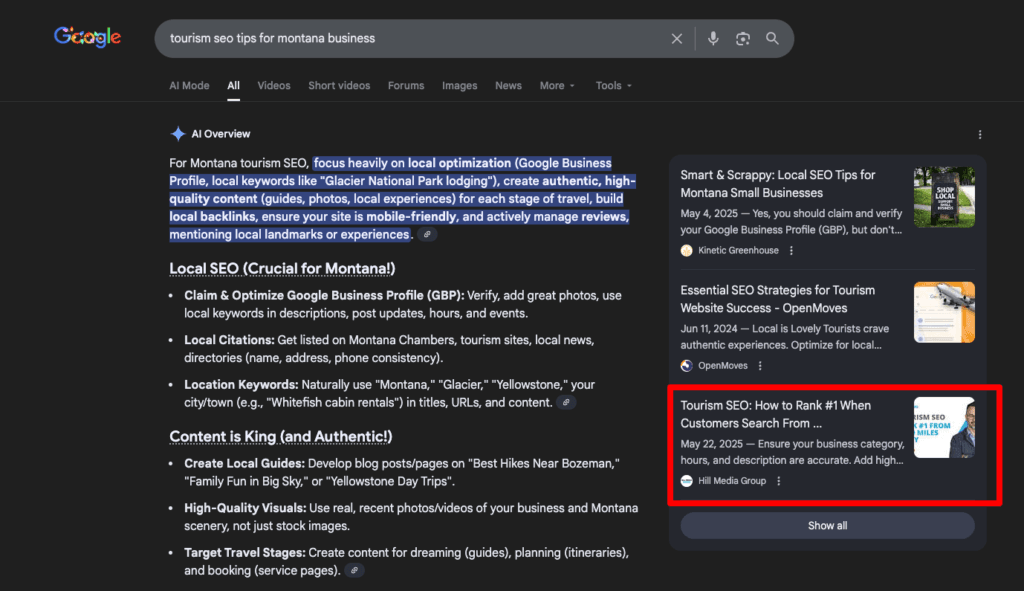
Example 1: SEO for Tourism Businesses in Montana
I wrote an article about SEO strategies for tourism businesses in Montana. Now when someone searches for this topic, I show up in organic Google results, Google’s AI Overviews, and Perplexity. Google’s AI Overview includes me as a source. Perplexity quotes directly from my article.
Example 2: Search Marketing Expo Recap
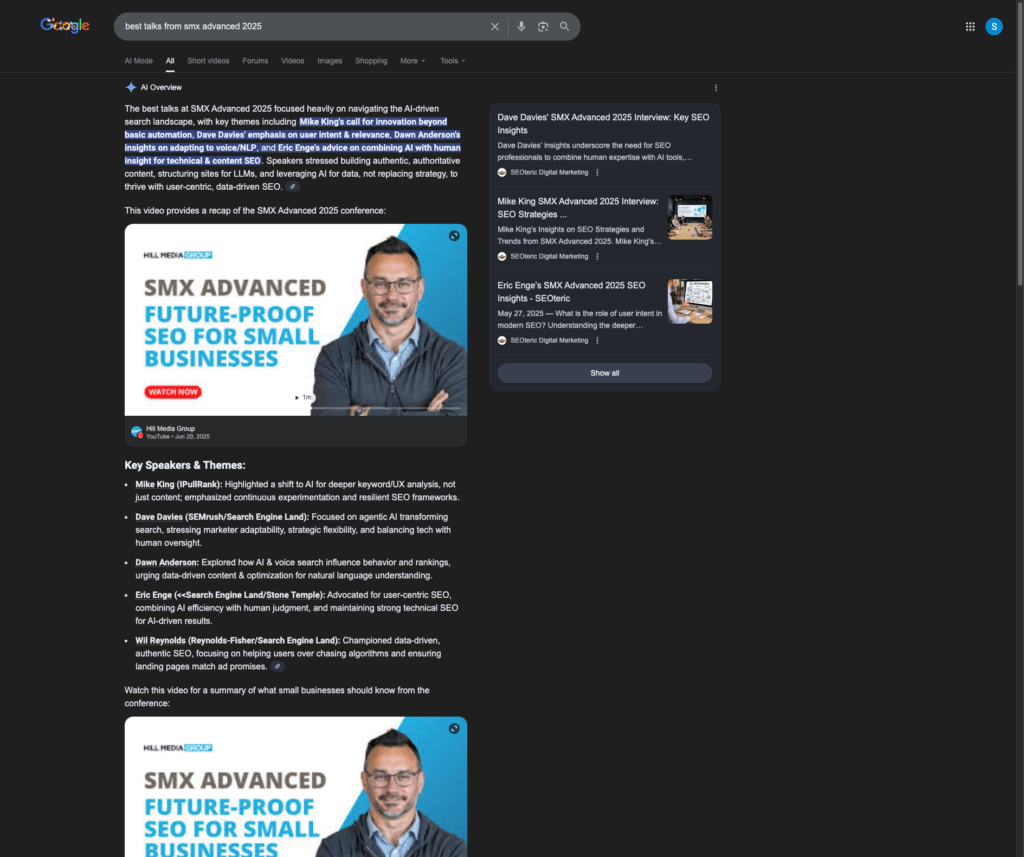
I wrote a recap of takeaways from the Search Marketing Expo Advanced Conference earlier this year and made an accompanying video. Now Google search, AI Overviews, and tools like Perplexity quote from my article and display my YouTube video in results.
Example 3: Rest vs. Idleness
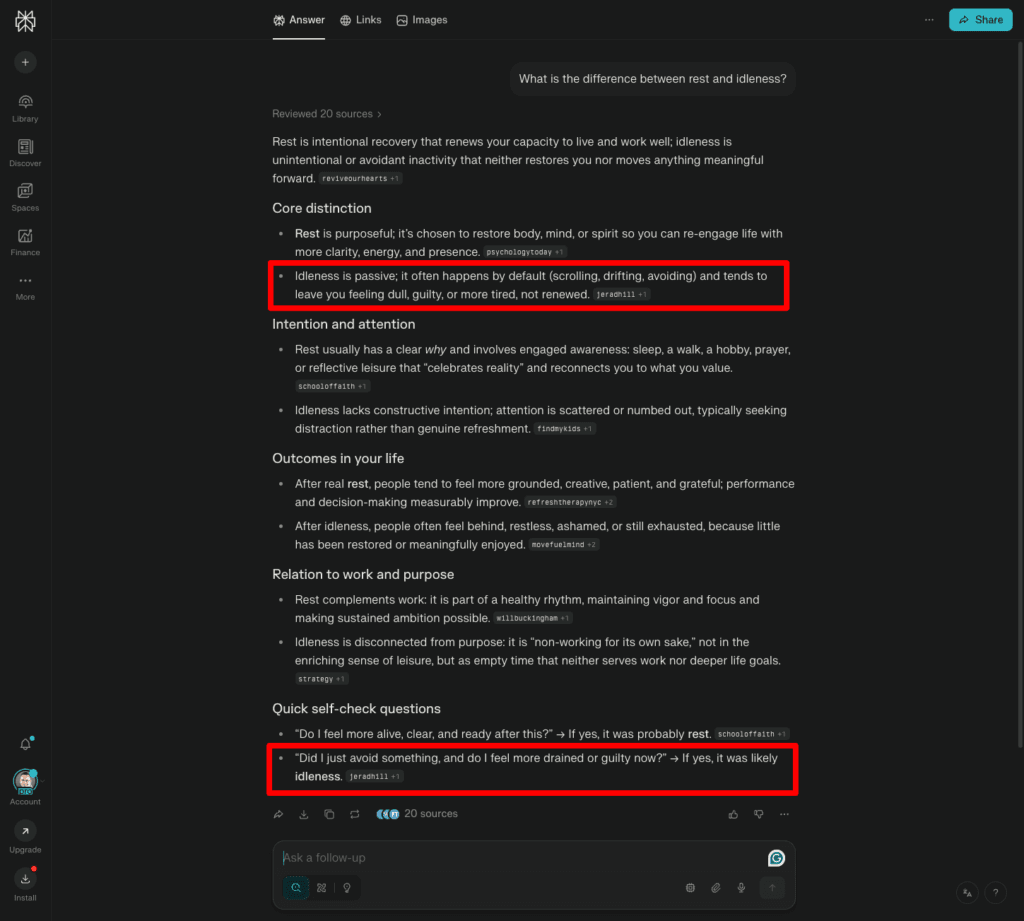
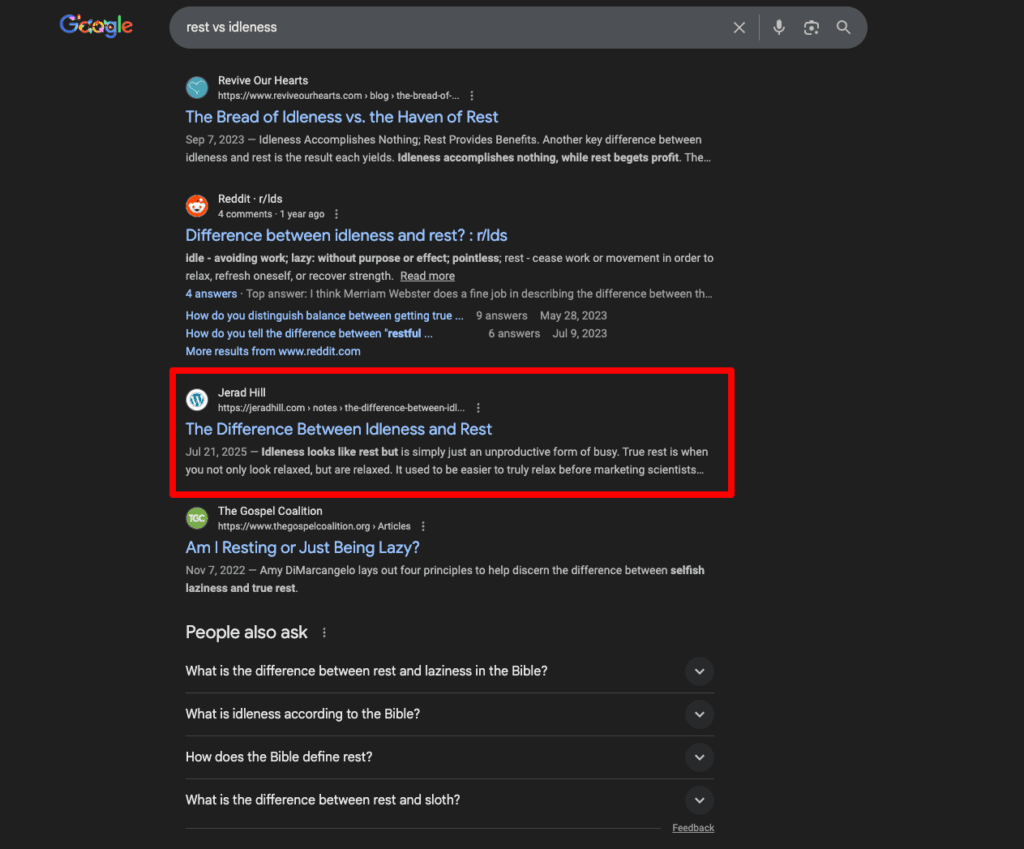
On my personal website—not Hill Media Group—I wrote about the difference between rest and idleness. I rank highly in Google when you search “rest vs idleness.” AI Overviews and Perplexity quote me directly.
This is content that would typically come from psychology websites or religious sources. I’ve never positioned myself in either category. But AI doesn’t care about your domain authority in the traditional sense—it cares whether your perspective is coherent, verifiable, and helpful.
Example 4: iPhone Case Reviews
I made a video reviewing 21 iPhone 17 Pro Max cases. That video has received over 190,000 views on YouTube and regularly appears in AI results. Here’s what’s remarkable: AI tools can crawl the video content and include references to it without even sharing the video with the person searching. All videos are transcribed, and those transcriptions feed Google Search and AI tools, making it easy for them to know what’s discussed in videos.
The Wild West: Why Domain Authority Matters Less Than You Think
The “rest vs. idleness” example reveals something important about this moment: AI is leveling the playing field.
About 90% of ChatGPT citations come from sources outside the top 20 Google search results. Read that again. The websites winning in AI search are often not the same ones winning in traditional search.
Traditional SEO rewards domain authority accumulated over years. AI rewards coherent, verifiable perspectives that help answer questions, regardless of who’s providing them.
If I were making things up in my “rest vs. idleness” article, AI would be able to verify that I’m full of it. My information wouldn’t line up with established knowledge. Because it does, it gets included—even though I’m not a psychologist or theologian.
Right now, there’s an opportunity for anyone with solid, well-reasoned opinions backed by reality. AI can verify whether your content aligns with established knowledge. When it does, you become part of the conversation—regardless of your credentials or domain authority.
This is the wild west. The rules are still being written. And the businesses creating authoritative, helpful content now are establishing themselves while competition is relatively low.
Understanding the AI Landscape: Why Someone Uses Perplexity vs. ChatGPT vs. Claude
Not all AI tools work the same way, and understanding the differences helps explain why showing up across multiple platforms matters.
Google AI Overviews and AI Mode
Google’s AI Overviews appear at the top of search results for about 47% of queries, particularly informational and how-to searches. AI Mode takes this further—93% of searches in AI Mode end without a click. Google pulls from its existing search index, which means traditional SEO still matters, but the presentation has fundamentally changed. Users get synthesized answers rather than a list of links to explore.
Perplexity
Perplexity is designed specifically as an “answer engine.” It performs real-time web searches for every query, includes inline citations throughout its responses, and is built for research-oriented users who want to verify sources. People use Perplexity when they want to understand how AI reached its conclusion and trace information back to its origins.
ChatGPT
ChatGPT dominates with 81% market share among AI chatbots. It’s conversational and task-oriented—people use it for everything from shopping research to coding to brainstorming. When browsing is enabled, it uses Bing’s search infrastructure. ChatGPT users are typically looking for conversation and task completion rather than pure research.
Claude
Claude (made by Anthropic) is known for nuanced, thoughtful responses and is often preferred for complex reasoning, writing, and analysis. It uses different search infrastructure than ChatGPT. Users tend toward Claude when they want depth and nuance in responses.
The point isn’t to optimize for one platform over another. It’s that different AI tools serve different user needs—and they’re all pulling from web content. If your content answers questions well, it has the potential to be cited across all of them.
What Businesses Are Risking By Not Creating Content
Let’s talk about the cost of inaction.
McKinsey research suggests that unprepared brands may experience traffic declines of 20 to 50 percent from traditional search channels. Organic traffic has already dropped 15-25% in some sectors due to AI search reducing click-through rates.
But traffic decline is just the surface-level concern. The deeper risk is invisibility.
When someone asks ChatGPT “what should I look for in a plumber in Kalispell?” or “how do I know if my HVAC system needs replacing?”—the businesses whose content has educated AI on those topics get mentioned. Everyone else simply doesn’t exist in that conversation.
AI creates a “winner-takes-most” scenario where only 2-3 sources get cited per query. In traditional search, you might appear on page two and still get some traffic. In AI search, you’re either in the answer or you’re largely invisible.
Here’s the timeline that should concern you: By 2028, $750 billion in US revenue will funnel through AI-powered search. That’s not speculative—that’s McKinsey’s projection based on current adoption curves.
If your business isn’t part of the information AI uses to answer customer questions, you’re missing out on those conversations entirely.
AI Agents Are Already Making Purchases
This isn’t just about search results. AI is moving into transactions.
In September 2025, Stripe and OpenAI launched the Agentic Commerce Protocol—an open standard that lets AI agents like ChatGPT buy things for users directly within conversations. ChatGPT users in the US can now buy from Etsy sellers without leaving the chat, with over a million Shopify merchants coming soon.
This isn’t about recommendations anymore. It’s about AI initiating and completing purchases on behalf of users.
Currently, only 24% of consumers feel comfortable letting AI complete purchases. But 64% have used or are open to using AI to complete a purchase. The comfort gap is closing.
Imagine where businesses will be who produced the necessary content for AI to answer customer questions versus those who never took the time. When someone asks their AI assistant to find and purchase a service, whose information will AI reference? If it’s not yours, it’s a competitor’s—or someone else who took the time to answer the questions.
How AI Decides What to Cite
Understanding how AI selects sources helps explain why creating content now is so important.
Google says that AI tools like AI Overviews operate as dynamic systems that retrieve and synthesize information in near real-time, though the frequency depends on the type of query and the source material’s volatility. Tools like ChatGPT use real-time web search integration, though frequency and depth vary based on user intent.
But here’s a practical reality: server processing is expensive and storage is cheap. Are these tools generating new information for every request, or are they storing and serving “less volatile” material? You can guess what’s more economically efficient.
This means that once your content makes it into AI’s system as a reliable source, you likely stay there—especially for stable queries. The crawl patterns I’m seeing on my own site support this. AI isn’t crawling once and leaving. It’s coming back consistently to check for new information.
77% of AI citations go to informational content. Commercial domains (.com) represent over 80% of citations. Wikipedia is ChatGPT’s most cited source at 7.8% of total citations, followed by Reddit for both Google AI Overviews (2.2%) and Perplexity (6.6%).
What does AI look for? Content that’s coherent, well-structured, answers questions directly, and can be verified against other sources. If your content helps AI answer questions accurately, you get cited.
Freshness Matters More Than Ever
Here’s a data point that changed how I think about content: ChatGPT reference URLs are about 393 days newer than those found in organic Google search results. In citation lists, that gap increases to 458 days.
AI strongly prefers fresh content.
Nearly 65% of AI bot hits target content published in just the past year. Content that once stayed relevant for 24-36 months now feels outdated in 6-9 months. If your content isn’t recently updated, fresher competitors will replace it in AI results.
This creates both challenge and opportunity. The challenge: you can’t “set and forget” content anymore. The opportunity: businesses that commit to consistent content creation will continually refresh their AI visibility while competitors with static websites fade.
The Coming Rise of Industry-Specific Content Sites
This shift could produce something interesting: a rise in industry-niche specific content sites.
Imagine a website that’s entirely about swimming pool maintenance—offering tips and tricks for pool ownership, but also information on what to look for in a pool cleaning business. This site isn’t selling pool services directly. It’s educating pool owners and, in doing so, becomes a trusted source that AI references when answering pool-related questions.
These niche content sites become bridges between consumers asking questions and businesses providing services. They fill the information gap that AI needs to give complete answers.
For local service businesses, this suggests an opportunity: creating the educational content that helps customers make informed decisions in your industry. Not sales pitches—genuine education that AI will use to help potential customers understand what they need.
What Content Should You Create?
Different stages of the customer journey require different types of content. AI understands context and will suggest videos where they make sense, provide product lists when appropriate, or continue asking questions until it’s absolutely sure what the user needs.
Think about your content strategy across three categories:
Questions Customers Ask Before Buying
What do people need to know before they even consider your type of product or service? For a plumber, this might be “signs your water heater is failing” or “how to know if you have a leak.” For an e-commerce business, it might be “how to choose the right [product category] for your needs.” This is educational content that positions you as helpful before anyone thinks about buying.
Questions Customers Ask While Evaluating Options
Once someone knows they need something, what questions guide their decision? “What to look for in a plumber” or “questions to ask before hiring a contractor” or “comparing [product A] vs [product B].” This is where you help customers make informed decisions—and where being cited means being in the room when decisions are made.
Questions Customers Ask After Buying
What do customers need help with after the purchase? Maintenance tips, troubleshooting guides, getting the most from their purchase. This content drives retention, referrals, and establishes ongoing expertise that AI will reference.
The format matters too. Video content is increasingly valuable—my iPhone case review video gets referenced by AI without AI even needing to share the video. All videos are transcribed, and those transcriptions feed AI tools. Written content, videos, podcasts—AI can consume all of it.
Why Starting Now Gives You an Advantage
AI tools are still learning and evolving. We’ve seen significant progress in their capabilities in 2025 alone. There are countless platforms ingesting information to either compete with today’s top AI tools or provide unique solutions.
These tools will look to minimize overhead by storing and reusing reliable source material. Whose information will they reference? If it’s not yours, it’s a competitor’s—or someone else who took the time to answer the questions.
The businesses creating authoritative, helpful content now are establishing themselves as trusted sources while competition is still relatively low. Once AI identifies you as reliable, it keeps coming back. The data from my own sites shows this—consistent crawl activity, not one-time indexing.
This doesn’t mean the opportunity disappears if you wait. But it will get harder—just like it’s gotten harder to rank organically in Google search over the years, and just like it’s become nearly impossible to gain ground on social media without paying for ads. The early movers have an advantage. The longer you wait, the more crowded it becomes.
Here’s the honest truth: most business owners don’t want to spend their days writing content and making YouTube videos. I get it. For local businesses, this will be easier because AI will narrow conversations to include local businesses. But for businesses with wider reach or online businesses like e-commerce, this competition will be much harder.
People won’t be scrolling through blue links in Google, making decisions based on how good your SEO title and description look. They’ll trust the results AI produces because that information came through a conversation—a process that includes discovering what the customer actually needs.
It’s like having a personal concierge. Now that AI tools have memory, they’ll remember user preferences and more quickly determine what they’re looking for.
The Path Forward
I’m not suggesting every business owner needs to become a content creator. But every business needs content that helps AI answer customer questions about their industry.
The businesses that win in this new landscape will be the ones whose content is coherent, verifiable, and genuinely helpful. Not sales pitches. Not keyword-stuffed SEO pages. Real answers to real questions that customers have.
My results came from consistent effort over time. I went from occasionally posting a few times a year to posting consistently. The payoff took about 60 days to materialize—and now AI tools keep coming back, checking for new information.
Creating content for AI search will only get more competitive from here. Right now, it’s still relatively easy to establish yourself. The question is whether you’ll start building that presence now—or fight for it later when everyone else has caught on.
Now is the easiest time it will ever be. That’s worth taking seriously.
Frequently Asked Questions
How do I get my business to show up in ChatGPT and AI search results?
AI tools cite content that directly answers questions, is well-structured, and can be verified against other sources. Start by creating educational content that addresses the questions your customers ask before, during, and after purchasing. Focus on being genuinely helpful rather than promotional—AI rewards coherent, verifiable perspectives over sales pitches. Consistency matters too; once AI identifies your site as a reliable source, it tends to keep coming back.
Related: How to Dominate AI Search Results: The New SEO Strategy Small Businesses Can’t Ignore
Why is my website traffic declining even though my Google rankings haven’t changed?
You’re likely experiencing the shift to zero-click search. 58.5% of Google searches now end without a click, and that number jumps to 93% in Google’s AI Mode. AI Overviews are answering questions directly on the search results page, so users don’t need to visit websites to get information. The solution isn’t to fight this trend—it’s to ensure your content is what AI cites when providing those answers.
Related: Why Your Website Traffic Is Declining (And What to Do About It)
What kind of content should I create to be cited by AI tools like Perplexity and Google AI Overviews?
Focus on three categories: questions customers ask before buying (educational content that builds awareness), questions they ask while evaluating options (comparison and decision-making content), and questions they ask after purchasing (maintenance, troubleshooting, getting more value). AI understands context and serves different content types based on user needs—written articles, videos, and even podcast transcripts all get indexed and cited.
Does traditional SEO still matter now that AI is answering questions directly?
Yes, but the game has changed. Google AI Overviews pull from Google’s existing search index, so traditional SEO fundamentals still help you get discovered. However, the presentation has shifted from “rank high and get clicks” to “be cited in the synthesized answer.” You need both: solid SEO to be indexed and discoverable, plus content structured to be useful for AI to reference.
Related: SMX Advanced 2025 Recap: What Small Businesses Need to Know About the Future of SEO
How do small businesses compete with big brands in AI search results?
This is actually where small businesses have an unexpected advantage right now. About 90% of ChatGPT citations come from sources outside the top 20 Google search results. AI rewards coherent, helpful content regardless of who creates it—not just established domain authority. If your content answers questions well and aligns with verifiable information, you can be cited alongside (or instead of) major brands.
Why are AI search tools citing my competitors but not my business?
Your competitors likely have content that directly answers the questions AI is trying to solve. Check what questions trigger their citations, then create better, more comprehensive content on those topics. AI prefers fresh content—URLs cited by ChatGPT are about 393 days newer than typical Google search results—so recently published, well-structured content has an advantage.
Related: The State of Small Business Marketing in 2025: What You Need to Know to Stay Competitive
What’s the difference between Google AI Overviews, ChatGPT, Perplexity, and Claude for search?
Google AI Overviews appear in about 47% of searches and pull from Google’s existing index. Perplexity performs real-time searches with inline citations—ideal for research-oriented users who want to verify sources. ChatGPT (81% market share) is conversational and task-oriented, using Bing’s infrastructure when browsing. Claude is preferred for complex reasoning and nuanced analysis. Different tools serve different needs, but they all pull from web content—if your content answers questions well, it can be cited across all of them.
How often do I need to update my website content to stay visible in AI results?
More often than you might expect. Content that once stayed relevant for 24-36 months now feels outdated in 6-9 months for AI tools. Nearly 65% of AI bot activity targets content published within the past year. This doesn’t mean rewriting everything constantly—but reviewing and refreshing your most important content quarterly, adding current examples and updated information, helps maintain visibility.
Will AI search replace Google, and what does that mean for my business?
AI search won’t replace Google entirely, but it’s fundamentally changing how people find and consume information. By 2028, $750 billion in US revenue is projected to flow through AI-powered search. The businesses that thrive will be those whose content AI uses to answer customer questions. If you’re not part of that information, you’re invisible during those conversations—regardless of how well you rank in traditional search.
How do I create content for AI search if I don’t have time to write articles or make videos?
Start with the questions your customers already ask you. Your sales team, support staff, and even your email inbox are full of real questions that need answers. Document those answers in whatever format works for you—written articles, video responses, or even transcribed audio. The format matters less than the substance. If creating content consistently isn’t realistic, working with a content marketing partner can help you build the library of answers AI needs to cite your business.
Learn more: Hill Media Group Content Marketing Services | Hill Media Group SEO Services
