Also in this series: Google I/O Just Changed the Rules. Here’s What Small Businesses Need to Know. hillmediagroup.com/google-io-2026-small-business-impact
It was a Thursday evening. I was leaving the office later than expected and remembered my wife had mentioned wanting a vanilla latte. Not just any vanilla latte — she has opinions about these things. I wanted to find the best one nearby, pick it up without breaking my commute, and arrive home having actually paid attention to something she cared about.
A year ago, that meant opening Google Maps, searching for coffee shops near me, tapping through three or four listings, checking menus to see if they even made lattes, reading a handful of reviews hoping someone mentioned the espresso drinks, and then making a judgment call with incomplete information. Possible. But a lot of steps for what should be a simple thing.
This time I tried something different. I opened Google Maps and used a new feature called Ask Maps. I typed: “coffee shop near me with the best vanilla latte.” That was it.
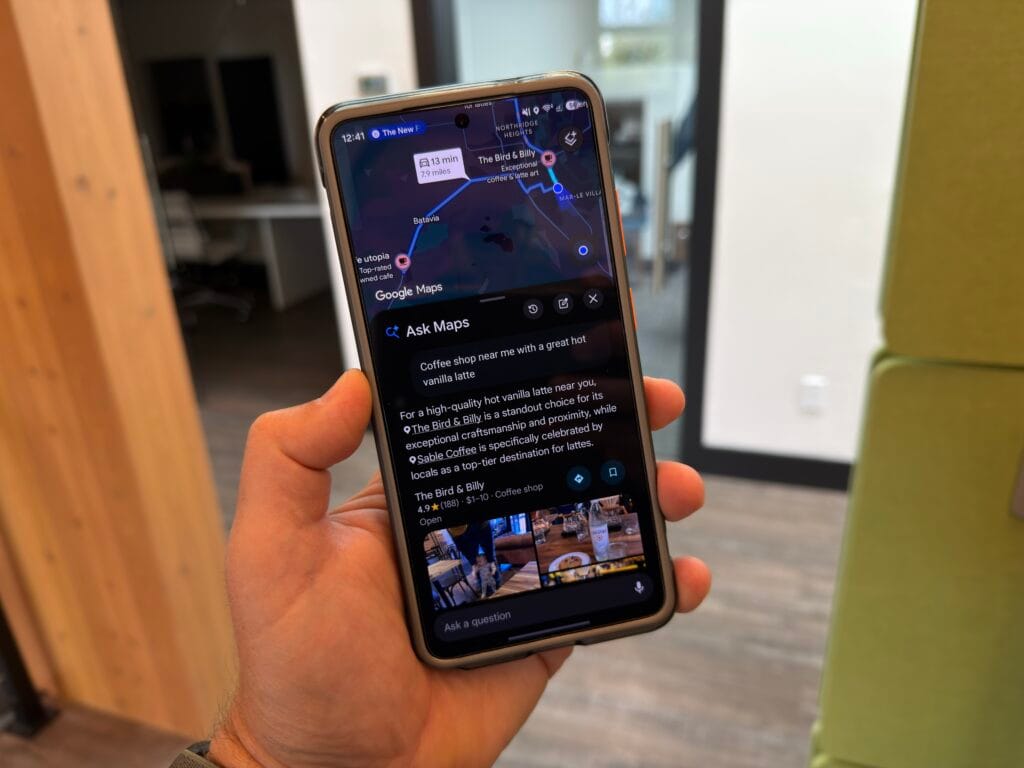
Ask Maps in Google Maps — searching for a specific drink rather than just a coffee shop nearby.
Maps looked at what was close to me, cross-referenced menus, pulled in review signals about specific drinks, and came back with a recommendation. One answer. No clicking through listings. No hunting for menu information. No hoping someone left a review specific enough to be useful.
I got my wife a great vanilla latte. She was happy. I was home on time. And I started thinking about what that experience means for every small business that depends on customers finding them.
What Just Happened — and Why It Matters
The latte story is a small thing. But the principle behind it is not.
Friction is anything that stands between a customer and the outcome they want. It is the extra tap, the missing information, the phone call they have to make, the form with too many fields, the website that takes ten seconds to load on a phone. Individually, any one of these things feels minor. Collectively, they are the reason someone chooses a competitor — often without consciously deciding to. They just went somewhere easier.
Customers have always preferred less friction. That is not new. What is new is that AI tools are now actively removing friction on the customer’s behalf, and the businesses that show up well in that process are the ones that have made their information accessible, specific, and structured in a way that AI can work with.
The businesses that have not done that work are not being penalized. They are simply being passed over. AI moves on to the next option that has given it something to work with, and the customer never knows your business existed.
Understanding friction — what creates it, what removes it, and how AI is changing the equation — is one of the most important things a small business owner can think about right now. Not because it is a new marketing tactic, but because it is the underlying force that determines whether customers choose you or someone else.
The Three Layers of Friction in Customer Decision Making
Not all friction is the same. To understand how AI is changing things, it helps to think about customer decisions in three distinct layers — each one representing a different kind of friction that AI is beginning to remove.
Layer One: Friction in Active Decisions
This is the most visible layer. A customer has a goal right now. They know what they want. The question is which business gets them there fastest.
The vanilla latte is a perfect example. I knew I wanted a latte. I knew I wanted it nearby. The friction was the research process — finding a place, verifying they made what I wanted, reading reviews to determine quality. Ask Maps collapsed all of that into a single query.
Think about what this means for your business. When someone searches for a plumber, a hair salon, a bakery, a landscaper, a restaurant — they are not searching because they enjoy the research process. They are searching because they need to get to the outcome. Every step between their query and their decision is friction. The business that provides the most specific, accessible, accurate information is the one AI can recommend with confidence.
Ask Maps is one example of this, but the same logic applies across Google Search, Yelp, Siri, ChatGPT, and any other AI-powered tool your customers use. The query is getting more conversational and more specific. The businesses with generic descriptions are getting filtered out. The businesses with specific, detailed, well-structured information are getting surfaced.
💡 What this means for you: Think about the most specific question a customer might ask to find your business. Does your website, your Google Business Profile, and your review content give AI enough detail to confidently match you to that question? If the answer is no, that is the first gap to close.
Layer Two: Friction in Recurring Tasks
The second layer is less obvious but arguably more important. These are the decisions customers make regularly — finding a reliable service provider, booking a recurring appointment, reordering a product they use consistently. The friction is not just in the research. It is in the entire process of getting from need to resolution.
Google recently demonstrated this with an AI agent called Gemini Spark. A homeowner tells the agent: “Find me a plumber with experience in older homes and book an appointment that works with my schedule.” The agent reads the homeowner’s calendar, evaluates local plumbers based on reviews and documented experience, identifies the right fit, and returns with a confirmed appointment.
No website visit. No phone call. No navigating a booking tool that requires creating an account. No back-and-forth trying to find a time that works. The customer stated their need once. The agent handled everything else.
Compare that to how most service businesses currently handle new customer inquiries. A potential customer finds your website. They look for a phone number or a contact form. They fill out the form and wait for a callback. Or they call and get voicemail. Or they find the booking tool, start the process, hit a snag, and give up. Every one of those steps is a point where you can lose the customer — not because they chose someone else deliberately, but because getting to you was just hard enough that they stopped trying.
AI agents like Gemini Spark are being built specifically to eliminate this kind of friction. The businesses that will benefit are the ones that have the right information in the right places — accurate service descriptions, documented specializations, strong review profiles, and booking systems that integrate with the tools these agents are connecting to.
Layer Three: Friction in Things We Forget Entirely
This is the layer that most businesses are not thinking about yet, but it represents the most significant shift in how customer decisions will be made in the coming years.
It is Friday afternoon. You are wrapping up a busy week. Somewhere in the back of your mind is the awareness that your son’s birthday party is on Sunday, and you need a birthday cake, but you have not had the bandwidth to actually deal with it. By Saturday morning it becomes a scramble — who is open, who can make something on short notice, who has what you need.
AI agents are being designed to handle exactly this kind of thing. They have access to your calendar. They know the birthday is Sunday. They know you have not booked a cake. On Thursday, before you even consciously think about it, your AI agent surfaces the reminder and takes the next step: here are three bakeries near you that have availability for Saturday pickup, here is what each one offers, would you like me to place an order?
This is not science fiction. Google’s Gemini Spark, announced in May 2026, operates precisely this way — a persistent agent running in the background, monitoring context, and surfacing timely decisions before the user has to remember to make them.
For businesses, this layer of AI behavior creates an entirely new category of opportunity. The bakery that has its Saturday availability, its custom cake options, and its ordering process connected to systems that AI agents can read and interact with is the one that gets recommended before the customer even thinks to search. The bakery that relies on phone calls and walk-ins will not show up in that conversation at all.
The businesses that are easiest for AI to work with — clear information, connected systems, real reviews, structured availability — will have access to customer decisions that happen before the customer is even consciously making them. That is a meaningful competitive advantage.
The Tools That Are Reducing Friction Right Now
Understanding friction is one thing. Knowing which tools are actively reducing it — and what your business needs to do to benefit from them — is where the rubber meets the road. Here are the most significant tools shaping customer experience right now and what each one means for your business.
Google Ask Maps
Ask Maps is Google’s conversational search feature inside Google Maps. Instead of searching for a business category and browsing results, customers can describe exactly what they want — the specific drink, the type of service, the particular need — and Maps uses menus, reviews, photos, and business information to recommend the best match.
For your business to show up in Ask Maps results, three things matter most. Your Google Business Profile needs to be complete and specific — not just your category and hours, but your actual services, your specializations, and the details that distinguish you. Your menu or service list needs to be accurate and detailed, because Ask Maps pulls directly from that information. And your reviews need to include specific language about what customers experienced — the more your reviews mention specific services, products, or qualities, the more signal Ask Maps has to work with.
The coffee shop that shows up when someone asks for the best vanilla latte is not necessarily the highest-rated coffee shop overall. It is the one whose profile, menu, and reviews gave Maps enough specific information to make a confident recommendation.
Google Gemini Spark
Gemini Spark is Google’s persistent AI agent — announced in May 2026 and rolling out to Google AI subscribers. It runs continuously in the background with access to a user’s calendar, Gmail, location history, and search behavior. It can research service providers, evaluate options based on reviews and documented experience, and book appointments on the user’s behalf.
For service businesses, Gemini Spark represents both an opportunity and a test. The businesses that have strong Google Reviews, complete and specific Google Business Profiles, and booking systems that integrate with Google’s ecosystem will be the ones Spark recommends and can actually take action on. A business that can only be booked by phone, or whose information is incomplete, falls out of the conversation entirely.
The practical implication: if you do not have an online booking option connected to a system like Google’s reservation integration, that is worth addressing. If your Google Business Profile has minimal information or outdated details, Spark has nothing credible to work from. If you have very few Google Reviews, or your reviews are old, Spark treats that as a trust gap.
Google’s Universal Cart
For businesses that sell products — whether through an e-commerce website, a local retail shop, or both — Google’s Universal Cart changes how purchasing decisions happen. Customers can add products from anywhere on the web and the cart monitors pricing, availability, and deals in the background. Purchasing decisions increasingly happen inside Google’s interface rather than on your website.
The friction this removes for the customer is significant. They no longer have to visit multiple websites to compare prices, navigate different checkout flows, or remember where they saw a product they wanted. Google handles the aggregation and makes it easy to complete the purchase.
For product sellers, being connected to Google’s commerce ecosystem through platforms like Shopify, WooCommerce, or Google Merchant Center is the foundation. From there, the businesses that win will be the ones with the most credible combination of competitive pricing and strong customer reviews. The businesses that treat their product listings as an afterthought will be less visible in a system that is actively doing the comparison shopping on the customer’s behalf.
Google Business Profile
This is not a new tool, but it has become the single most important piece of digital real estate a local business owns — and most businesses are not using it to its full potential.
Your Google Business Profile is the primary source of information that AI tools use to represent your business in search results, in Maps, in Gemini responses, and increasingly in agent-driven recommendations. It is where Ask Maps pulls menu and service information. It is where Gemini Spark looks for business details when evaluating whether to recommend you. It is the first thing a customer sees when they search your business name directly.
A complete, accurate, and regularly updated Google Business Profile is not optional in an AI-driven search environment. It is the foundation everything else is built on.
- Add every service you offer with specific descriptions — not just categories
- Keep your hours accurate, including holiday and seasonal changes
- Upload real photos regularly — interior, exterior, team, work in progress
- Use the Posts feature to share updates, offers, and relevant content
- Respond to every review, positive and negative — this signals an active, engaged business
- Enable messaging if you are able to respond within a reasonable window
Online Booking and Scheduling Tools
One of the most common friction points in service businesses is the gap between a customer deciding they want to hire you and actually getting an appointment on the calendar. Phone tag, limited hours for calls, booking tools that require account creation, forms that ask for more information than necessary — each of these adds steps between intent and conversion.
Tools like Calendly, Acuity Scheduling, and Google’s own booking integration allow customers to see real availability and book directly without a phone call. When these tools are properly connected to your Google Business Profile, AI agents like Gemini Spark can surface your availability and facilitate booking without the customer ever needing to visit your website or make a call.
The friction principle here is simple: every step you remove between a customer’s decision and a confirmed appointment is a step where you could have lost them. The businesses that make booking frictionless will convert more of the customers who find them.
Review Collection Systems
Reviews are trust infrastructure. They are also one of the primary signals that AI tools use to evaluate whether a business is worth recommending. But most businesses treat review collection as an afterthought — they hope satisfied customers will leave a review on their own, and some do, but most don’t because nobody asked.
A systematic approach to review collection does not have to be complicated. The most effective method is an automated follow-up — an email or text sent two to three days after a completed job or purchase with a direct link to your Google review page. No extra steps, no account required, just a direct path to leaving the review.
The businesses that collect reviews consistently and recently will have a structural advantage in AI recommendations over businesses with older, sparser review profiles. Recency matters because it signals that the business is actively operating and consistently delivering good experiences.
What Friction Really Costs
It is easy to think of friction as a minor inconvenience — something that slows customers down a little but does not fundamentally change the outcome. The data tells a different story.
Studies on e-commerce consistently show that adding a single additional step to a checkout process can reduce conversions by double-digit percentages. A one-second delay in page load time reduces customer satisfaction measurably. Requiring account creation before checkout is one of the leading causes of cart abandonment. These are not marginal effects.
In a world where AI agents are doing the searching, evaluating, and booking on behalf of customers, friction has an even more significant effect. It is not just that a customer might get frustrated and leave. It is that an AI agent evaluates your business in a fraction of a second and determines whether you are worth recommending based on the quality and completeness of your information. If the information is missing, incomplete, or difficult to access, the agent moves on. The customer never knows you were an option.
This is why the shift happening right now matters so much for small businesses. The playing field is not just about having a website anymore. It is about having the right information, in the right format, in the right places, so that the tools making recommendations on behalf of your customers can find you, trust you, and act on your behalf.
Less friction always wins. That has always been true. What is new is that the bar for what counts as friction just got significantly higher, and the tools raising that bar are already in your customers’ pockets.
Where to Start
If you are thinking about where to focus first, start with the things that have the most direct impact on how AI tools evaluate and recommend your business right now.
Start with your Google Business Profile. Treat it like a second website. Fill out every field. Write specific service descriptions. Add real photos. Make sure your hours are accurate. This is the foundation that every other AI tool builds on.
Build a review collection system. Even a simple automated follow-up email after every job is a meaningful improvement over hoping customers review on their own. The goal is recency and consistency — a steady stream of recent, specific reviews carries more weight than a large volume of old ones.
Audit your booking or contact process. Walk through it as a customer. Count the steps. Ask honestly: at which point would a busy person give up? Every step you can remove is a customer you keep.
Make your information specific. On your website, your Google profile, and anywhere else you appear online, replace generic descriptions with specific ones. Not “we offer plumbing services” but “we specialize in residential plumbing for older homes, including galvanized pipe replacement and low-pressure diagnostics.” Specificity is what AI matches against customer questions.
The businesses that do this work now are building an advantage that will compound over time. The businesses that wait will find themselves in a market where the rules have already changed and the gap is harder to close.
Frequently Asked Questions
What exactly is friction in a customer experience context?
Friction is anything that adds steps, confusion, or effort between a customer’s intent and the outcome they want. It can be a slow website, a contact form with too many fields, a phone number that is hard to find, a booking tool that requires creating an account, or a service description so vague that a customer cannot tell whether you do what they need. Individually these things seem minor. Collectively they determine whether a customer completes the process of hiring you or quietly moves on to someone easier to work with.
How does Google Ask Maps work and how does it find specific businesses?
Ask Maps is a conversational search feature inside Google Maps that allows users to describe what they want in natural language rather than searching by category or business name. Instead of searching for “coffee shop near me” a user can ask for “a coffee shop near me with the best vanilla latte” and Maps will evaluate nearby businesses using their menu information, review content, photos, and Google Business Profile data to find the best match. The businesses that show up are the ones whose profile and review content contains specific enough information for Maps to confidently make the recommendation.
Does my business need to do anything special to show up in Ask Maps results?
Not special — but specific. Ask Maps pulls from the information that already exists in your Google Business Profile and your reviews. The more specific and detailed that information is, the better positioned you are. Make sure your services or menu items are listed with descriptive language, that your profile category and attributes are accurate, and that your reviews include specific mentions of what customers experienced. A review that says “great coffee” helps less than a review that says “the vanilla latte here is the best I have had in town.” Encourage customers to be specific when they review you.
What is Gemini Spark and will it really book appointments without customers visiting my website?
Gemini Spark is a persistent AI agent from Google that runs continuously on behalf of individual users, with access to their calendar, email, and location context. It can research service providers, evaluate them based on reviews and documented experience, and book appointments without the user having to manually search or navigate a website. It is currently rolling out to Google AI subscribers. As it becomes more mainstream, the businesses with complete Google profiles, strong reviews, and integrated booking systems will be the ones agents like Spark can actually take action on. Businesses that can only be contacted by phone will not be actionable through these tools.
I run a retail shop, not a service business. Does friction apply to me the same way?
Yes, and in some ways even more directly. For product sellers, friction shows up in how easily customers can find your products through search, how many steps your checkout process requires, how clearly your product descriptions answer the questions customers have before buying, and how visible you are in tools like Google’s Universal Cart. Every unnecessary step in the path from discovering a product to completing a purchase is a point where you can lose the sale. The businesses that reduce those steps — through detailed product listings, streamlined checkout, and presence in Google’s commerce ecosystem — will convert more of the customers who find them.
How important are online reviews for showing up in AI recommendations?
They are among the most important signals AI tools use when making recommendations. Reviews provide two things that AI needs: credibility signals that confirm the business is legitimate and delivers on its promises, and specific language that helps AI match the business to particular customer needs. A plumber whose reviews frequently mention experience with older homes will be recommended to customers asking for that specific thing. A plumber with generic reviews or very few reviews gives AI agents less to work with. Collecting reviews consistently, through an automated follow-up system, is one of the highest-return investments a small business can make right now.
My business only takes bookings by phone. Do I really need an online booking tool?
You do not have to switch entirely — but having an online booking option alongside your phone line removes a significant friction point for customers who prefer not to call, and more importantly, makes your business actionable by AI agents like Gemini Spark that cannot make phone calls on a customer’s behalf. Even a simple scheduling link through a tool like Calendly or Google’s built-in booking integration, connected to your Google Business Profile, gives AI something to work with when a customer asks it to book an appointment. The goal is not to replace the phone call. It is to make sure you are accessible through the channels AI agents can interact with.
What is Google’s Universal Cart and how does it affect product sellers?
Google’s Universal Cart is a cross-platform shopping tool that lets customers add products from anywhere on the web — search results, YouTube videos, Gmail, the Gemini app — and the cart works in the background monitoring pricing, availability, and deals. For product sellers, this means purchasing decisions increasingly happen inside Google’s interface rather than on your website. Being connected to Google’s commerce ecosystem through platforms like Shopify, WooCommerce, or Google Merchant Center is the starting point. From there, competitive pricing and strong customer reviews are the signals that determine how often your products get surfaced in that environment.
How do I make my Google Business Profile more useful for AI tools?
Treat it like your most important marketing asset, not a directory listing. Fill out every available field. Write specific descriptions for each service you offer rather than listing generic categories. Upload real photos of your team, your work, and your location on a regular basis. Keep your hours accurate and update them for holidays. Respond to every review. Use the Posts feature to share current updates. Enable messaging if you can respond promptly. The more complete, specific, and recently updated your profile is, the more useful it is to the AI tools that pull from it when making recommendations.
What is the single highest-impact thing I can do right now to reduce friction for my customers?
Audit your contact and booking process from the customer’s perspective. Open your website on a phone, find your contact information, and try to book an appointment or get a question answered as if you were a new customer who knows nothing about your business. Count every tap, every field, every step. Ask at which point a busy person would give up. Then remove as many of those steps as possible. A direct booking link, a visible phone number on every page, a contact form that asks only for what is essential — these changes require minimal technical effort and have immediate impact on how many of the customers who find you actually follow through.
Is Your Business Easy to Find, Trust, and Hire?
The shift toward AI-driven customer decisions is already underway. The businesses that are paying attention now — building their information, their reviews, and their processes around reducing friction — will have a compounding advantage over the businesses that wait until the rules have fully changed.
At Hill Media Group, we help small businesses build the foundation that makes them visible and accessible in the environment that is coming. If you want to understand where your business stands and what the highest-impact next steps are, schedule a free 15-minute Digital Growth Strategy Session.
Schedule your free strategy session at hillmediagroup.com/l/strategy
Crafting your digital success,
Jerad Hill | Hill Media Group
